
1 July 2026 | By Team Mahanadaya
Every organisation wants sustainable growth. Yet, many continue to compete on price, products or promotional campaigns that competitors can easily replicate.
True competitive advantage works differently.
It is built on something far more difficult to copy- TRUST.
When customers consistently believe in your expertise, your recommendations and your ability to solve complex business problems, your organisation moves beyond being a supplier. Instead, it becomes the preferred advisor.
That is the essence of thought leadership.
Today, thought leadership is no longer a branding exercise reserved for large corporations. Rather, it has become a strategic business asset that influences buying decisions, strengthens reputation, attracts premium clients and creates long-term market differentiation.
Research continues to validate this shift. The 2024 Edelman–LinkedIn B2B Thought Leadership Impact Report found that high-quality thought leadership significantly improves perceptions of organisational capability while directly influencing purchase decisions among senior decision-makers. Similarly, recent findings from the HubSpot State of Marketing show that educational, expert-led content consistently delivers stronger engagement than purely promotional communication. Meanwhile, both Harvard Business Review and McKinsey emphasise that trust has become one of the strongest drivers of organisational resilience and sustained competitive advantage. (Edelman)
The question, therefore, is no longer whether businesses should invest in thought leadership.
The real question is how to build it systematically.
For organisations that need a structured growth partner, Mahanadaya brings together strategic consulting, communication and digital execution through its integrated services, shaped by the firm’s consulting philosophy and journey.
Why Thought Leadership Creates Sustainable Advantage
Unlike advertising, thought leadership compounds over time.
Each article, keynote, podcast, research paper, webinar and executive interview strengthens market credibility. Consequently, every valuable insight increases visibility while simultaneously reinforcing authority.
Furthermore, search engines increasingly reward organisations that demonstrate genuine experience, expertise, authoritativeness and trustworthiness (E-E-A-T). Therefore, businesses that consistently publish original insights are more likely to improve both search visibility and brand reputation.
Most importantly, thought leadership reduces perceived buying risk.
In practice, this is where business advisory and compliance support, market research and analysis and marketing analytics help convert thought leadership from opinion into evidence-backed business direction.
Prospective clients prefer organisations that educate before they sell because expertise signals confidence, while education demonstrates competence.
The Mahanadaya TRUST Framework™
At Mahanadaya, we believe sustainable thought leadership is never accidental. Instead, it follows a structured methodology known as the TRUST Framework™.
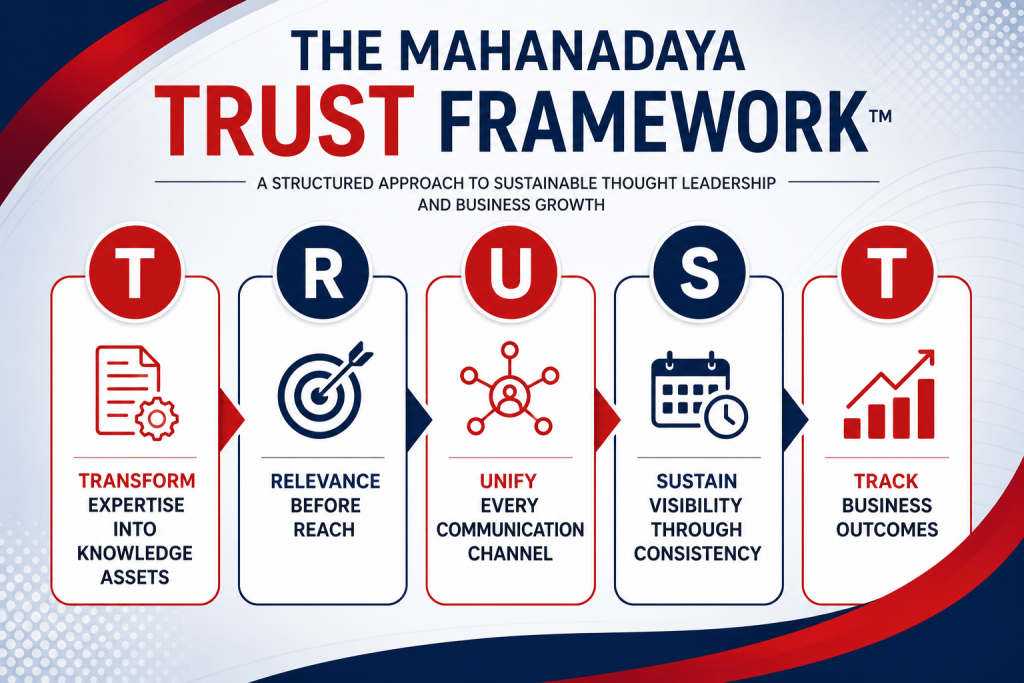
T — Transform Expertise into Knowledge Assets
Capture practical experience and convert it into articles, reports, white papers, research, videos and executive insights.
R — Relevance Before Reach
Create content that solves genuine business challenges rather than simply increasing publishing frequency.
U — Unify Every Communication Channel
Align public relations, executive branding, SEO, digital marketing and content strategy around a single positioning narrative.
S — Sustain Visibility Through Consistency
Thought leadership succeeds because organisations remain visible over months and years—not because they publish once.
T — Track Business Outcomes
For example, the TRUST Framework™ works best when personal branding and thought leadership, corporate branding and identity, public relations, content creation and search engine optimisation support one consistent market narrative.
Measure visibility, engagement, authority, qualified enquiries and business impact instead of vanity metrics alone.
This integrated approach allows organisations to build credibility that competitors cannot easily imitate.
Lorem ipsum dolor sit amet, consectetur adipiscing elit. Ut elit tellus, luctus nec ullamcorper mattis, pulvinar dapibus leo.
Five Proven Ways Thought Leadership Creates Competitive Advantage
1. Builds Trust Before the First Conversation
Modern buyers complete much of their evaluation before contacting a business.
Consequently, organisations that consistently publish expert insights establish familiarity long before sales discussions begin. Rather than convincing prospects during meetings, they reinforce beliefs already formed through valuable content.
2. Positions Executives as Industry Authorities
People trust people before they trust companies.
Therefore, executive thought leadership strengthens organisational credibility.
When leaders regularly contribute informed opinions, participate in conferences, publish articles and comment on industry developments, their personal authority naturally enhances corporate reputation.
3. Creates Higher-Quality Leads
Therefore, strong thought leadership should also connect with go-to-market strategy to execution, a measurable lead generation engine, search engine marketing and wider digital marketing transformation so that visibility becomes qualified business opportunity.
Educational content attracts audiences actively seeking solutions.
As a result, organisations generate enquiries from prospects who already understand their expertise.
Instead of chasing leads, thought leaders attract informed decision-makers.
Business Insight
Organisations that consistently educate their markets often experience shorter sales cycles because trust has already been established before commercial discussions begin. Thought leadership shifts conversations from “Why should we trust you?” to “How can we work together?”
It also performs better when supported by strong website strategy and design, consistent marketing and communications and high-quality marketing collateral, design and print that keep the brand experience coherent across every touchpoint.
4. Improves Long-Term Search Visibility
Search engines increasingly reward comprehensive, original and experience-driven content.
Consequently, organisations that publish research-backed insights strengthen their organic visibility while simultaneously improving brand authority.
Unlike paid advertising, this visibility continues generating value long after publication.
5. Creates Brand Preference Beyond Price
Products evolve.
Technology changes.
Pricing fluctuates.
However, trusted expertise remains remarkably resilient.
Consequently, organisations recognised for thought leadership often command premium positioning because customers associate expertise with lower business risk.
Thought Leadership vs Traditional Marketing
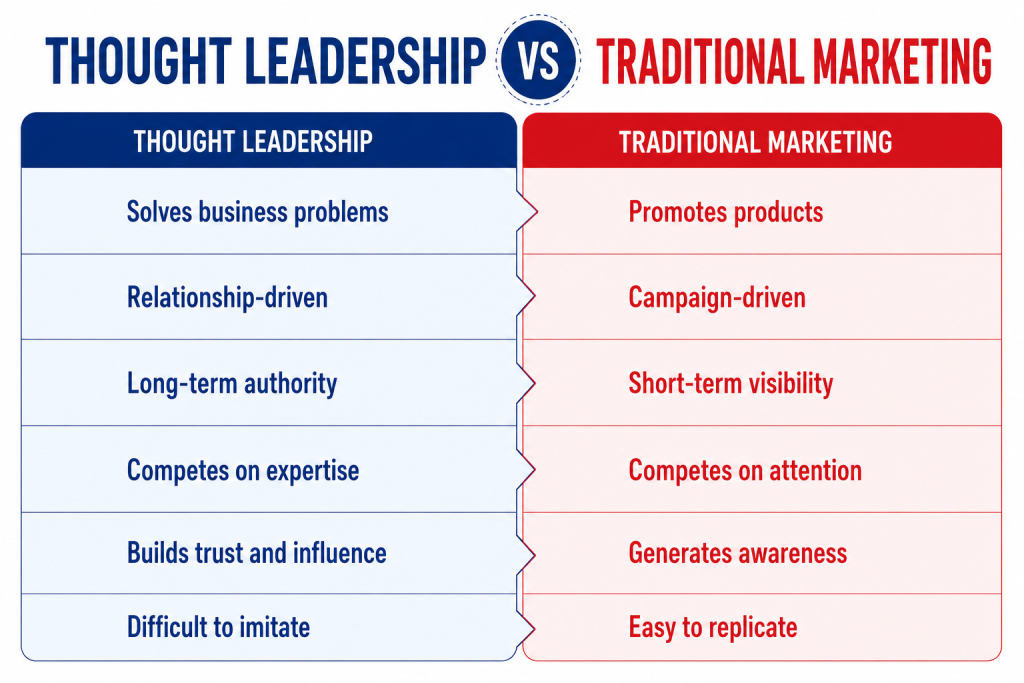
The strongest organisations combine both approaches. Marketing creates awareness, whereas thought leadership creates preference.
The wider learning from such engagements can be developed into insights, shared through relevant media resources and, where the mandate involves social impact, strengthened through CSR advisory and management.
A Mahanadaya Success Story
One professional services organisation wanted to move beyond conventional promotional campaigns.
Rather than increasing advertising expenditure, the organisation invested in a structured thought leadership programme centred on knowledge sharing.
Mahanadaya developed a comprehensive strategy combining executive positioning, webinar-led knowledge marketing, SEO-focused content creation, digital amplification and performance analytics.
Within 100 days, the initiative delivered measurable business outcomes, including:
- More than 200 qualified registrations from highly relevant professionals for a webinar.
- Approximately 81% growth in the organisation’s professional community.
- Over 1.5 lakh awareness impressions across integrated digital channels.
- Strong engagement that transformed educational content into meaningful business conversations.
Most importantly, the organisation strengthened market credibility while building a repeatable lead-generation engine based on expertise rather than aggressive promotion.
The result was not simply greater visibility.
It was sustainable competitive advantage.
Building Thought Leadership Requires an Integrated Strategy
Publishing occasional blogs rarely creates lasting authority.
Instead, organisations need an ecosystem that combines executive branding, strategic content creation, search engine optimisation, public relations, digital marketing, marketing analytics and performance measurement.
When these disciplines work together, every article strengthens reputation.
Every media mention reinforces authority. Each webinar expands credibility. Search ranking increases discoverability. Eventually, these cumulative effects become a significant competitive moat.
Final Thoughts
Markets evolve rapidly, yet one business principle remains remarkably consistent.
People choose organisations they trust.
Thought leadership creates that trust by demonstrating expertise before buyers ask for it.
Over time, this trust compounds into stronger reputation, higher-quality opportunities, improved search visibility and sustainable business growth. You can explore the full Mahanadaya services portfolio, review current insights and media resources, or contact Mahanadaya to discuss a customised thought leadership roadmap.
While competitors can copy products, pricing or campaigns, they cannot easily replicate years of authentic expertise shared consistently with the market.
That is precisely why thought leadership has become one of the most enduring competitive advantages available to modern organisations.
For students and young professionals who want to learn through live consulting exposure, Mahanadaya also offers careers and internship opportunities across content, research, branding, digital marketing and communications.
FAQs
Q1. What is thought leadership, and why is it important for long-term competitive advantage?
Thought leadership means consistently sharing original, experience-backed insights that help customers solve real business challenges. Unlike traditional marketing, it builds long-term trust, strengthens brand authority and creates sustainable competitive advantage. Moreover, many organisations improve market positioning by combining Personal Branding & Thought Leadership with strategic content and executive visibility. Learn more: https://mahanadaya.com/personal-branding-and-thought-leadership/
Q2. How does thought leadership help build trust with customers?
Thought leadership builds trust because it educates before it sells. When businesses publish valuable articles, research, case studies and expert opinions consistently, customers begin viewing them as trusted advisors instead of vendors. Therefore, a well-planned Content Strategy supported by Digital Marketing Transformation helps these insights reach the right audience. https://mahanadaya.com/digital-marketing-transformation/
Q3. What are the five proven ways to build trust, authority and sustainable business growth through thought leadership?
The five most effective strategies include publishing original research, building executive visibility, earning media credibility, creating consistent knowledge-led content and measuring performance. In addition, organisations can combine Go-to-Market Strategy to Execution, Public Relations, SEO and executive branding to achieve sustainable business growth. https://mahanadaya.com/go-to-market-strategy-to-execution/
Q4. How does data-driven content improve business credibility?
Data-driven content improves credibility because it supports opinions with evidence, customer insights and measurable outcomes. Consequently, audiences trust organisations that demonstrate expertise instead of making unsupported claims. For this reason, businesses that invest in Market Research & Analysis produce stronger thought leadership because every recommendation is backed by evidence. https://mahanadaya.com/market-research-and-analysis/
Q5. What types of content work best for thought leadership?
The most effective thought leadership assets include research reports, white papers, executive blogs, case studies, podcasts, webinars, industry reports, keynote presentations and long-form SEO articles. However, these assets work best when they are planned, written and distributed with a clear brand narrative. As a result, professional Content Creation & Storytelling and Marketing Collateral Design services help maintain quality across every customer touchpoint.
Q6. How can businesses start building thought leadership quickly?
First, identify one core area of expertise before developing a content roadmap around it. Next, publish SEO-focused articles, executive LinkedIn posts, webinars and industry insights at a consistent pace. Additionally, combining Digital Marketing Transformation with Search Engine Optimisation helps accelerate visibility while building long-term authority. https://mahanadaya.com/digital-marketing-transformation/
Q7. Why is executive thought leadership important for business growth?
People trust experts before they trust organisations. Therefore, executives who publish articles, speak at conferences and share industry perspectives strengthen both personal and corporate credibility. In particular, a structured Personal Branding & Thought Leadership strategy helps leaders become recognised voices within their industries. https://mahanadaya.com/personal-branding-and-thought-leadership/
Q8. How does public relations support thought leadership?
Media coverage provides independent third-party validation that advertising cannot achieve. Consequently, organisations featured in respected publications build stronger credibility while reaching new audiences. Furthermore, integrating Public Relations with thought leadership creates lasting authority rather than temporary visibility. https://mahanadaya.com/public-relations/
Q9. How can businesses balance thought leadership with commercial objectives?
Successful organisations educate before they promote. Instead of pushing products, they solve customer problems through valuable insights, practical frameworks and industry expertise. Therefore, aligning this approach with a well-defined Go-to-Market Strategy ensures thought leadership contributes directly to qualified business growth. https://mahanadaya.com/go-to-market-strategy-to-execution/
Q10. How do you measure the success of a thought leadership strategy?
Measure business outcomes rather than vanity metrics. For example, useful indicators include organic traffic, search rankings, engagement quality, media mentions, qualified enquiries, conversion rates and pipeline influenced by content. In addition, Marketing Analytics enables organisations to refine strategy and demonstrate measurable return on investment. https://mahanadaya.com/marketing-analytics-inner-page/
Q11. What role does company culture play in successful thought leadership?
A culture that encourages learning, innovation and knowledge sharing creates authentic expertise that customers trust. Meanwhile, businesses undergoing Corporate Branding & Identity transformation can strengthen internal knowledge-sharing practices so employees become ambassadors for the brand’s expertise. As a result, thought leadership becomes a company-wide capability rather than a one-person activity. https://mahanadaya.com/corporate-branding-identity-services/
Q12. How can businesses keep their thought leadership relevant?
Review content regularly, monitor industry developments and update articles with new research, customer insights and emerging trends. In addition, businesses that continuously invest in Market Research & Analysis produce more relevant and authoritative content. Consequently, their thought leadership performs better for both readers and search engines. https://mahanadaya.com/market-research-and-analysis/
Q13. Should company leaders actively participate in thought leadership?
Yes. Executive participation humanises the organisation while increasing credibility with customers, investors and partners. Moreover, combining executive visibility with Corporate Branding, Personal Branding and strategic content creates a powerful leadership presence that competitors find difficult to replicate. https://mahanadaya.com/corporate-branding-identity-services/
Q14. How can businesses avoid superficial or empty thought leadership?
Authentic thought leadership combines practical experience, research, customer outcomes and proven frameworks. However, businesses must also ensure their expertise is communicated consistently across websites, blogs, social media, public relations and marketing collateral. Therefore, an integrated approach to Digital Marketing Transformation, Marketing Communications and Public Relations keeps every customer interaction aligned with the organisation’s authority. https://mahanadaya.com/digital-marketing-transformation/
Q15. What are the biggest mistakes businesses make when building thought leadership?
The most common mistakes include publishing inconsistent content, focusing only on promotion, ignoring customer needs, failing to measure performance, neglecting SEO and producing generic AI-generated articles without genuine expertise. However, organisations that integrate branding, executive visibility, content marketing, analytics and customer education are far more likely to achieve sustainable business growth.
Ready to Build Your Organisation’s Thought Leadership Strategy?
Whether you are looking to strengthen executive visibility, improve search performance, generate qualified leads or establish long-term market authority, Mahanadaya helps organisations transform expertise into measurable business growth through integrated thought leadership, strategic content, digital marketing, public relations and brand positioning.
The most successful brands are not always the loudest.
They are the ones the market trusts first.
𝗜𝗳 𝘆𝗼𝘂𝗿 𝗶𝗻𝘀𝘁𝗶𝘁𝘂𝘁𝗶𝗼𝗻 𝗼𝗿 𝗼𝗿𝗴𝗮𝗻𝗶𝘀𝗮𝘁𝗶𝗼𝗻 𝗶𝘀 𝗳𝗼𝗰𝘂𝘀𝗲𝗱 𝗼𝗻 𝗮𝗰𝗮𝗱𝗲𝗺𝗶𝗰 𝗲𝘅𝗰𝗲𝗹𝗹𝗲𝗻𝗰𝗲, 𝗶𝗻𝗱𝘂𝘀𝘁𝗿𝘆 𝗿𝗲𝗹𝗲𝘃𝗮𝗻𝗰𝗲, 𝗮𝗻𝗱 𝘀𝘁𝗿𝗮𝘁𝗲𝗴𝗶𝗰 𝘁𝗿𝗮𝗻𝘀𝗳𝗼𝗿𝗺𝗮𝘁𝗶𝗼𝗻, then get in touch with Mahanadaya
 Call at : 9911455093
 Write to us: contact@mahanadaya.com
 Learn more: https://mahanadaya.com/