

2 July 2026 | By Team Mahanadaya
Visibility attracts attention. Knowledge earns trust.
Every day, businesses compete for clicks, impressions and followers. However, visibility alone does not always translate into qualified leads or sustainable business growth. In fact, many organisations discover that increasing traffic without building trust produces disappointing commercial results.
Today, modern buyers are more informed than ever before. Instead of responding instantly to promotional messages, they research independently, compare providers and seek expert guidance before making decisions.
Consequently, this changing behaviour has made Knowledge Marketing one of the most effective approaches for organisations that want to build authority, not just awareness.
By contrast, unlike traditional digital marketing, which often focuses on generating immediate traffic through advertisements and promotions, Knowledge Marketing positions expertise as the asset that attracts opportunities.
Throughout this guide, you will discover five practical ways to use Knowledge Marketing to attract qualified prospects, strengthen brand authority and create a sustainable lead generation engine.
Table of Contents
- What is Knowledge Marketing?
- Why Businesses Are Moving Beyond Traditional Digital Marketing
- 5 Smarter Ways to Use Knowledge Marketing
- Conclusion
- Frequently Asked Questions
What is Knowledge Marketing?
Definition
Knowledge Marketing is the strategic process of educating your audience through valuable expertise, practical insights and evidence-based guidance to build trust before selling products or services.
Instead of asking customers to buy immediately, Knowledge Marketing demonstrates why your organisation deserves their confidence.
Instead of saying, “Choose our company,” Knowledge Marketing says, “Here is how you can solve your problem. If you need support implementing the solution, we are ready to help.”
Ultimately, this subtle change transforms marketing from self-promotion into customer education. As a result, businesses become trusted advisors instead of simply another supplier competing on price.
Knowledge Marketing vs Traditional Digital Marketing
In reality, the strongest organisations use both approaches together. Nevertheless, Knowledge Marketing provides the trust layer that improves the performance of SEO, digital advertising and lead generation campaigns.
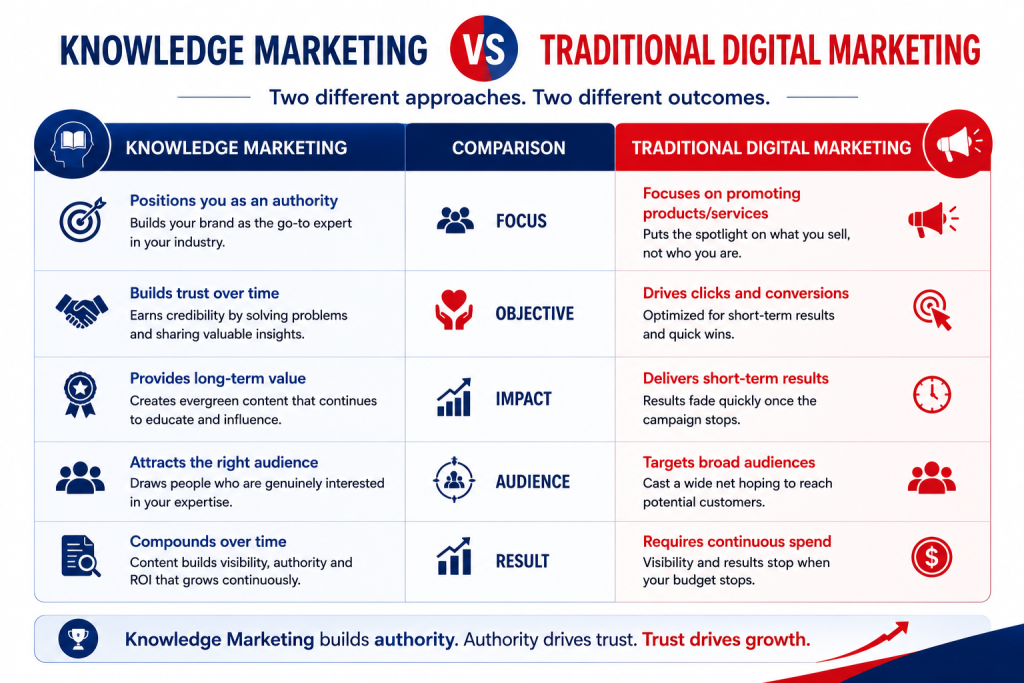
For organisations looking to move from campaign-led visibility to trust-led growth, Mahanadaya’s strategic marketing and communications services help connect brand positioning, content, SEO and lead generation into one cohesive growth system.
Why Businesses Are Moving Beyond Traditional Digital Marketing
Digital marketing is not disappearing. Rather, it is evolving.
Before making a purchase, today’s buyers consume articles, webinars, expert opinions, case studies and comparison content before speaking to a supplier. Therefore, organisations that educate early often enter the sales conversation with stronger credibility.
According to Edelman’s Trust Barometer, technical experts and subject matter specialists continue to be among the most trusted voices in business communication.
Google’s Think with Google insights also show that buyers increasingly rely on digital research during decision-making.
Consequently, businesses that consistently share expertise attract prospects who are already informed, more qualified and easier to convert.
T^hus, it is clear that Knowledge Marketing does not replace traditional digital marketing. Instead, it makes digital marketing smarter by giving audiences a reason to trust the brand before they are asked to buy.
5 Smarter Ways to Use Knowledge Marketing
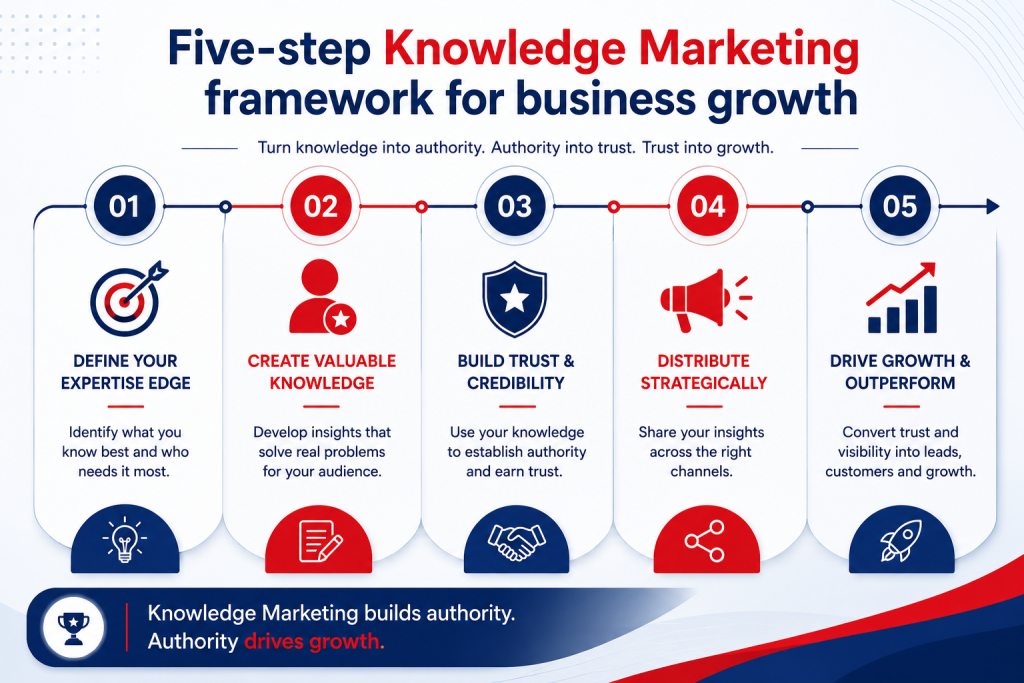
1. Educate Before You Sell
The biggest difference between promotional marketing and Knowledge Marketing is intent.
Traditional campaigns often begin with the product. Knowledge Marketing begins with the customer’s problem.
For example, instead of publishing a post about your digital marketing services, explain how businesses can improve lead quality, increase brand visibility or strengthen customer retention.
Useful educational content includes:
- How-to guides
- Industry reports
- Frameworks
- Whitepapers
- FAQs
- Checklists
- Research articles
- Webinars
Each asset answers genuine customer questions while positioning your organisation as a credible source of expertise.
Businesses looking to develop a structured educational content strategy can align Knowledge Marketing with Content Creation & Storytelling, Search Engine Optimisation and Marketing & Communications to ensure every content asset supports measurable business value.
2. Build Executive Thought Leadership
People trust people before they trust organisations.
That is why executive visibility has become a powerful component of Knowledge Marketing.
When founders, CXOs and subject matter experts regularly share insights through LinkedIn articles, media interviews, conference talks, podcasts and opinion pieces, they humanise the brand while increasing organisational credibility.
Research from LinkedIn’s B2B Institute shows that thought leadership influences buyer perception and strengthens long-term commercial relationships.
For instance, a consulting firm can use founder-led articles to explain market shifts, compliance changes, sector opportunities or customer behaviour. Similarly, a technology company can use expert-led content to simplify complex innovation for business decision-makers.
Organisations seeking to scale executive influence can combine Knowledge Marketing with Personal Branding & Thought Leadership so their expertise reaches decision-makers across LinkedIn, media, events and search-led discovery.
3. Turn Customer Questions into Searchable Knowledge Assets
Every sales call, client meeting or networking conversation reveals valuable insights into what your audience wants to know.
Instead of answering these questions repeatedly, convert them into content that works for your business around the clock.
Examples include:
- Frequently Asked Questions (FAQs)
- How-to guides
- Industry checklists
- Explainer videos
- Whitepapers
- Case studies
- Comparison articles
- Decision-making frameworks
Each piece of content becomes a long-term digital asset that educates prospects while improving your search engine visibility.
Moreover, search engines increasingly reward websites that demonstrate first-hand experience, topical authority and helpful content. Organisations that consistently answer genuine customer questions are therefore more likely to rank for high-intent searches.
To maximise results, combine educational content with Website Strategy & Design, Search Engine Optimisation and Marketing Analytics so your knowledge assets are discoverable, user-friendly and continuously optimised for performance.
4. Support Expertise with Research, Data and Real-World Evidence
Knowledge Marketing is built on credibility, not opinions.
Every recommendation should be supported by practical experience, reliable research or measurable outcomes.
For example, when discussing customer trust, reference findings from recognised organisations such as Edelman, Google, McKinsey, Harvard Business Review help. Likewise, strengthen your content with industry benchmarks, original surveys and real business outcomes wherever possible.
Case studies are particularly powerful because they demonstrate how knowledge translates into measurable business impact.
For example, Mahanadaya has helped organisations transform educational content into lead generation engines, strengthen executive thought leadership and improve organic visibility through knowledge-led marketing strategies. These engagements illustrate that consistently sharing expertise attracts qualified audiences and builds long-term business credibility rather than short-term campaign results.
Businesses looking to communicate success stories effectively can integrate Marketing Collateral & Design, Public Relations and Corporate Branding & Identity Services to present expertise in a credible and compelling manner.
5. Amplify Knowledge Across Multiple Digital Channels
Creating valuable knowledge is only the first step.
The next challenge is ensuring that the right audience discovers it.
Rather than publishing a blog and hoping it gains traction, distribute every piece of content strategically across multiple touchpoints.
A typical Knowledge Marketing distribution strategy includes:
- Website blogs
- LinkedIn articles
- Executive LinkedIn posts
- Email newsletters
- Webinars
- Podcasts
- Media articles
- Industry forums
- YouTube videos
- Search Engine Optimisation
- Social media content
This integrated approach ensures that a single piece of expertise generates value across multiple channels.
For example, one research article can become a webinar, several LinkedIn posts, an infographic, a short video, an email campaign and a downloadable guide. Consequently, content delivers significantly higher returns without requiring constant new production.
Organisations aiming to build a scalable knowledge ecosystem often combine Digital Marketing Transformation, Lead Generation Engine, Search Engine Marketing and Go-to-Market Strategy to Execution to amplify visibility while nurturing prospects throughout the buyer journey.
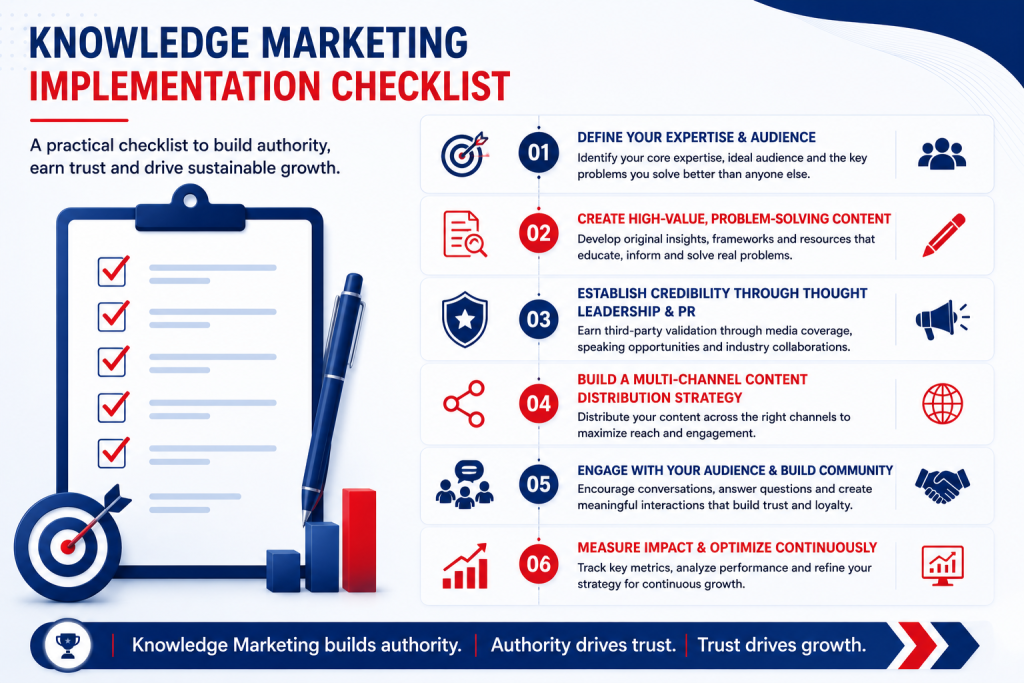
Before publishing your next piece of content, ask yourself:
✔ Does it solve a real customer problem?
✔ Is it based on expertise or evidence?
✔ Does it educate before selling?
✔ Have you supported claims with credible research?
✔ Does it answer a question people actively search for?
✔ Can it be repurposed into multiple content formats?
✔ Does it naturally guide readers towards your products or services?
If the answer is “yes” to most of these questions, your content is already aligned with Knowledge Marketing principles.
Common Mistakes to Avoid
Many organisations attempt Knowledge Marketing but fail to realise its full potential because they:
- Focus on selling instead of educating.
- Publish content without understanding customer search intent.
- Ignore SEO best practices.
- Produce inconsistent content.
- Fail to measure performance.
- Rely on generic AI-generated articles without adding original expertise.
- Neglect executive thought leadership.
Avoiding these mistakes helps create content that continues attracting qualified prospects long after publication.
Conclusion
Knowledge Marketing is not a replacement for traditional digital marketing—it is the strategy that makes every marketing activity more effective.
By educating before selling, organisations build credibility, strengthen customer relationships and attract prospects who already recognise their expertise.
The five approaches discussed in this guide demonstrate that authority is built through consistent knowledge sharing rather than constant promotion.
Businesses that invest in market research, executive thought leadership, educational content, credible evidence and multi-channel distribution are better positioned to earn trust, improve search visibility and generate sustainable business growth.
If your organisation wants to move beyond campaign-led marketing and establish itself as a recognised industry authority, Mahanadaya’s Business Advisory & Compliance Services and Digital Marketing Transformation services can help convert expertise into structured business growth.
For more insights on branding, digital marketing, PR and growth strategy, explore the Mahanadaya Insights section or contact Mahanadaya to discuss a knowledge-led marketing roadmap.
Whether you are building a startup, scaling a professional services firm or transforming an established enterprise, integrating Knowledge Marketing with strategic branding, digital marketing and lead generation can create a lasting competitive advantage.
Frequently Asked Questions
- What is Knowledge Marketing?
Knowledge Marketing is the practice of sharing valuable expertise, insights and educational content to build trust before promoting products or services. It positions organisations as trusted advisors rather than just vendors.
How is Knowledge Marketing different from content marketing?
Content marketing focuses on creating and distributing content. Knowledge Marketing goes further by ensuring that every piece of content demonstrates expertise, solves genuine customer problems and strengthens authority.
Why is Knowledge Marketing important for B2B businesses?
B2B buyers research extensively before making purchasing decisions. Knowledge Marketing helps organisations educate prospects, build credibility and generate higher-quality leads throughout this journey.
- Does Knowledge Marketing improve SEO?
Yes. Educational, experience-led content aligns with Google’s Helpful Content principles and E-E-A-T framework, increasing opportunities for organic search visibility.
- Can startups benefit from Knowledge Marketing?
Absolutely. Startups can compete with larger organisations by demonstrating expertise, sharing industry insights and building trust without relying solely on expensive advertising.
- What types of content work best for Knowledge Marketing?
Blogs, guides, whitepapers, case studies, webinars, podcasts, research reports, FAQs, videos and executive thought leadership articles all contribute to an effective Knowledge Marketing strategy.
- How often should businesses publish Knowledge Marketing content?
Consistency is more important than frequency. Publishing one high-quality, research-backed article each week often delivers better long-term results than producing large volumes of promotional content.
- How can executives contribute to Knowledge Marketing?
Founders and subject matter experts can publish LinkedIn articles, speak at industry events, participate in podcasts and share professional insights that reinforce organisational credibility.
- Is Knowledge Marketing suitable for small businesses?
Yes. Small businesses can establish authority by answering customer questions, showcasing expertise and creating educational resources that larger competitors may overlook.
- How can Mahanadaya help organisations implement Knowledge Marketing?
Mahanadaya helps organisations build Knowledge Marketing ecosystems through market research, corporate branding, executive thought leadership, content creation, PR, SEO, digital transformation and lead generation strategies that convert expertise into measurable business growth.
𝗜𝗳 𝘆𝗼𝘂𝗿 𝗶𝗻𝘀𝘁𝗶𝘁𝘂𝘁𝗶𝗼𝗻 𝗼𝗿 𝗼𝗿𝗴𝗮𝗻𝗶𝘀𝗮𝘁𝗶𝗼𝗻 𝗶𝘀 𝗳𝗼𝗰𝘂𝘀𝗲𝗱 𝗼𝗻 𝗮𝗰𝗮𝗱𝗲𝗺𝗶𝗰 𝗲𝘅𝗰𝗲𝗹𝗹𝗲𝗻𝗰𝗲, 𝗶𝗻𝗱𝘂𝘀𝘁𝗿𝘆 𝗿𝗲𝗹𝗲𝘃𝗮𝗻𝗰𝗲, 𝗮𝗻𝗱 𝘀𝘁𝗿𝗮𝘁𝗲𝗴𝗶𝗰 𝘁𝗿𝗮𝗻𝘀𝗳𝗼𝗿𝗺𝗮𝘁𝗶𝗼𝗻, then get in touch with Mahanadaya
Call at: 9911455093
Write to us: contact@mahanadaya.com
Learn more: https://mahanadaya.com/